How to Identify Otter Field Signs: Spraints, Footprints and Feeding Remains
You can walk the same stretch of river for years and never see an otter. That doesn't mean they aren't there. Otters are largely nocturnal, hold long territories, and vanish into cover at the first crunch of gravel under a boot. Working out whether they use a particular stretch of water is mostly a matter of reading what they leave behind: droppings, prints, slides and the leftovers of a meal. The difficulty is that mink, foxes, badgers, herons and dogs leave marks in the same places. Here's how to sort one from another.
Start with the places otters actually use
Otter signs aren't spread evenly along a bank. They cluster at landmarks that otters pass and re-mark, so a productive walk means checking a handful of specific spots rather than scanning every metre of mud.
Look here first: bridge ledges, buttresses and the tops of arches; the mouths of tributaries; both ends of an island; large mid-stream boulders; gravel spits; stone revetments and weirs; the apron of a ford; and the flat grassy patches in reedbeds where an otter might lie up. Anywhere a low, heavy animal has to pause, climb or squeeze past is worth a second look.
Timing matters as much as location. Go out after rain, when mud and silt hold prints cleanly. In dry spells, hunt for older prints while frost or low, slanting sun still outlines them — a thin skin of ice or a heavy dew can reveal a whole night's traffic in a way that flat daylight does not.
Spraints: the single most reliable sign
Spraints are otter droppings, and they are the field sign you are most likely to find. Unlike many mammals, otters do not bury their scat. They deposit it in conspicuous places — on top of a boulder, on a bridge ledge, on a grassy tussock, at the junction of a tributary, or on a gravel spit. These are not random toilets; they are scent marks, and the same spots are used again and again, sometimes for generations.
Fresh spraint is dark, almost black, and often glistens with moisture. It may be tarry or slimy, and it frequently contains visible fish bones, scales, and fragments of crayfish shell. The smell is distinctive: musky, fishy, and often described as similar to a mixture of hay, jasmine tea, and a fish market. It is not unpleasant in the way that fox or dog scat can be, but it is strong. As it ages, spraint turns grey and brittle, then crumbles into a pale, chalky deposit that can persist for weeks.
Otter spraints are usually deposited in small, neat piles or scattered along a ledge, and they are often accompanied by other signs. If you find a fresh spraint, slow down and look around: there may be footprints in the mud below, a slide into the water, or the remains of a meal nearby.
"A fresh spraint on a midstream boulder is the single most reliable sign that an otter is using a stretch of water. Learn its smell and you will never confuse it with mink."
Spraint versus mink, fox and badger
Mink scat is the most common confusion. It is smaller, often more twisted or tapered, and usually contains fur, feathers, and seeds as well as fish. It smells foul and rancid rather than musky. Mink also tend to deposit scat in similar places, but they are more likely to use the same spot repeatedly in a small area, creating a middling latrine. Otter spraint is generally larger, more uniform, and often placed higher and more prominently.
Fox scat is larger, often deposited on paths, grass tussocks, or stones, and frequently has a twisted tail. It may contain fur, feathers, seeds, and sometimes bone, but it rarely contains fish scales. The smell is distinctly fox — acrid and unpleasant. Badgers use designated latrines, often in shallow pits or on flat ground, and their scat is usually soft, dark, and full of earthworm remains or fruit stones. Badger latrines are often near setts and are not usually on midstream rocks.
Footprints: reading the mud
Otter footprints are one of the most satisfying signs to find, because they tell you not just that an otter was there, but how it was moving. The best places to look are soft mud, silt, sand, or snow along the water's edge, especially at the top of a bank, on a slipway, or around a ford.
An otter's forefoot print is broad and rounded, with five toes and a large, roughly triangular pad. The toes are often connected by visible webbing, especially in wet mud. The hind foot is longer and narrower, with a heel pad that may register. A typical forefoot print is about 5–7 cm wide and 6–8 cm long; the hind foot can be up to 9 cm long. When walking, otters often place their hind feet directly into or close to the prints of their forefeet, creating a distinctive overlapping track pattern.
In soft ground, you may also see a tail drag — a smooth, continuous line between the footprints. When moving faster, otters bound, and the prints appear in groups of four, with a gap between each group. In snow, they often slide, leaving a smooth trough with footprints at the start and end.
Telling otter prints from other animals
- Otter: five toes, broad pad, webbing often visible, no claws (usually), tail drag possible, bound or walk.
- Mink: five toes, smaller (2.5–4 cm), webbing less obvious, claws may show, often a bounding gait with prints in pairs.
- Dog: four toes, claws usually visible, larger, more oval, no webbing.
- Fox: four toes, claws visible, smaller than dog, often a narrow, direct register walk.
- Badger: five toes, broad, claws very visible, larger, often a shuffling gait.
- Cat: four toes, no claws, round, often direct register.
If you find a print with five toes, a broad pad, and no claw marks, you are almost certainly looking at an otter or a mink. Size and setting will usually settle it: mink are much smaller, and their prints are rarely as broad or as deeply impressed as an otter's.
Feeding remains: the leftovers of a meal
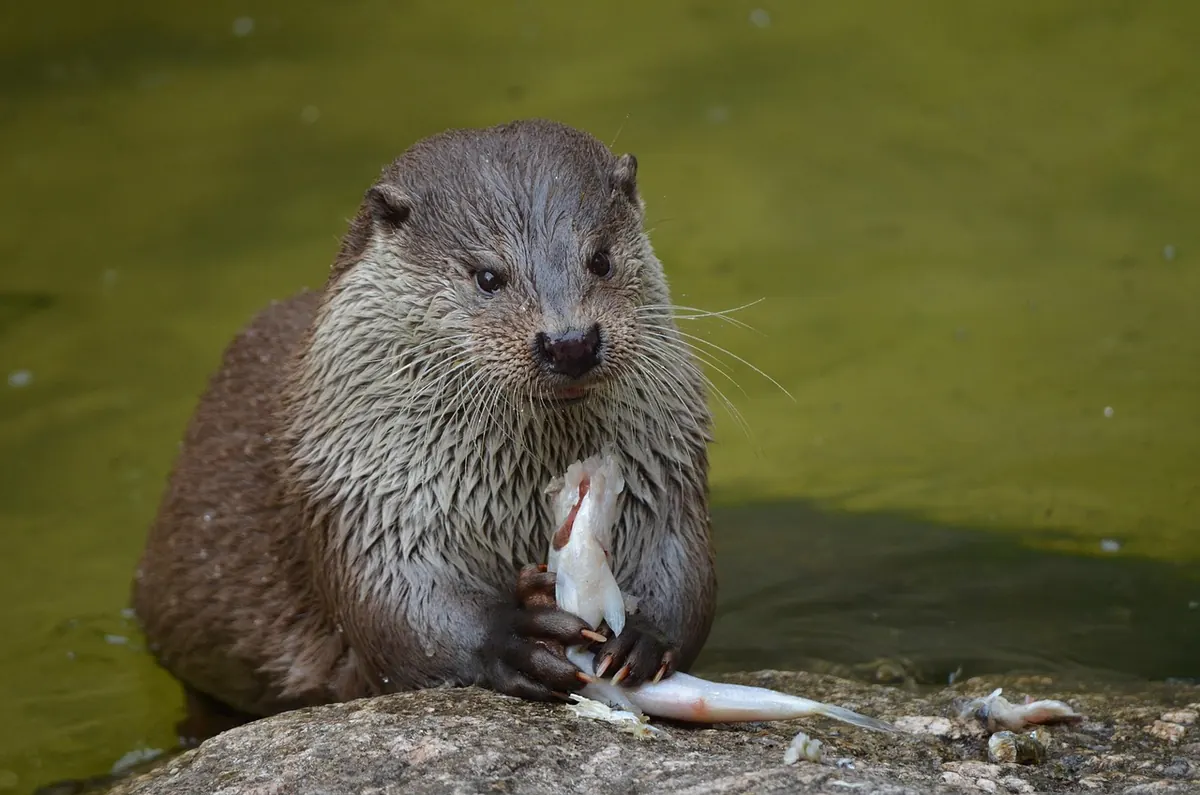
Otters eat a lot of fish, and they often bring their catch onto a flat rock, a gravel spit, or a grassy bank to eat. The remains can be obvious once you know what to look for. Fish scales are the most common sign: they are small, silvery, and often scattered on a rock or at the edge of a bank. You may also find fish bones, heads, tails, and fins. Otters often eat fish from the head down, leaving the tail and sometimes the skin. A large fish like a salmon or pike may be reduced to a pile of bones and scales.
Other prey leaves different remains. Amphibians, such as frogs and toads, may be represented by a pile of skin and legs. Birds are plucked, and you may find feathers scattered around a feeding site. Small mammals may leave fur and bones. In some areas, crayfish claws are a common sign: otters eat signal crayfish and leave the claws behind, often in small piles near the water's edge.
Feeding remains are often found near a spraint, because otters frequently mark the site after eating. Look for a flat rock that is stained or scattered with scales, and check the surrounding area for spraint and footprints.
Fe
Photo: NoName_13 / Pixabay