Otter Diet in UK Freshwater Habitats: What Droppings Reveal
A flat rock on the outside of a river bend, just above the waterline, with a dark twisted deposit on top of it. That is a spraint, and in British otter fieldwork it is often the most valuable thing you can find.
Otters are nocturnal, wary and mostly solitary, so surveys rely on signs rather than sightings. Droppings are the commonest sign, and they double as a meal record. Otters swallow prey in chunks and their gut does not grind bone to nothing, so scales, ear stones, jaw fragments, frog bones and feather shafts come out the other end more or less intact.
What a spraint actually tells you
A spraint is not just waste. Otters use it to mark territory, which is why it appears in predictable spots: boulders, bridge ledges, fallen trunks, tussocks, gravel spits and the mouth of a tributary. Learn those places and you stop hunting otters and start reading the river instead.
Identification takes practice. Otter spraint is dark, tapered and often twisted, and fresh examples smell sweet and musky, somewhere between hay and jasmine tea. Mink leave similar scats in similar places, but theirs tend to be more cylindrical, smell considerably worse and more often contain fur. Footprints, slides and runs help confirm what you are looking at.
Each spraint reflects a few recent meals, so a single find means little on its own. The useful patterns come from many samples, collected across seasons and sites.
Reading the remains
The method works because fish hard parts survive digestion. Otoliths, the small ear stones behind a fish's brain, are the most useful of them, and their shape often identifies the species. Stomach acid erodes them, so a spraint rarely yields a complete set. Other material fills the gaps:
- Scales — cycloid and ctenoid patterns narrow down the likely species, and they survive in numbers.
- Vertebrae and jaw bones — useful for confirming eel, pike or brown trout.
- Pharyngeal teeth — the throat teeth of cyprinids such as roach, chub, dace and minnow are robust, and the tooth arrangement differs between species.
- Amphibian and bird bones — limb, pelvis and skull fragments, plus feather shafts.
- Crayfish — pale, brittle shell and claw pieces, obvious on a white tray.
A simple sorting method
Set aside an hour and a kitchen table. The whole process is straightforward once you have a routine:
- Collect roughly a teaspoon into a labelled tube or bag. Note the date, grid reference and habitat.
- Freeze it if you cannot process it the same day. That stops it rotting and kills most of the smell.
- Soak the sample in warm water, then wash it through a sieve of about half a millimetre. A tea strainer works at a push, though the smallest otoliths will escape.
- Spread the residue thinly on a white tray and work through it with a hand lens or a low-power microscope.
- Pick out otoliths, teeth, bones, scales and feathers into separate labelled containers.
- Record each prey type as present or absent in each spraint. Counting individuals from paired otoliths and jaw bones is possible for a few species only.
What turns up in British rivers
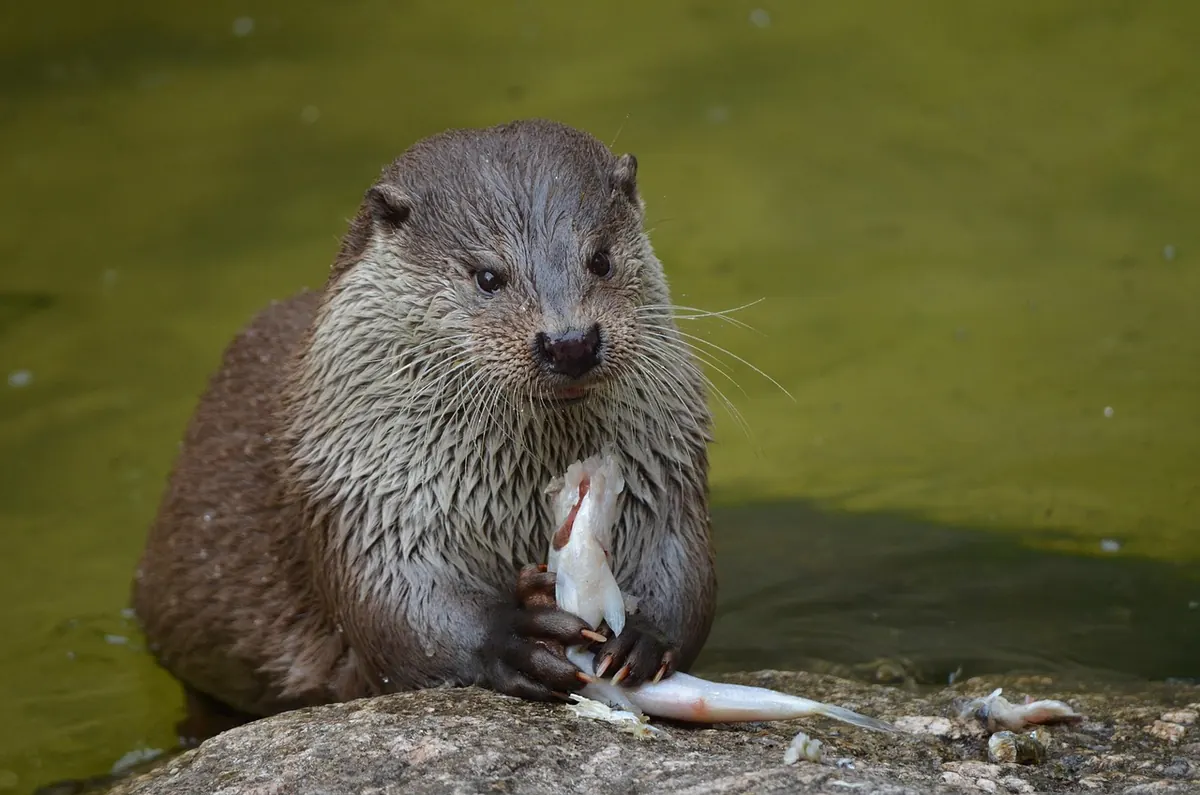
Freshwater otter diet leans heavily on fish, and not the ones anglers usually think about. Small, slow, bottom-living species dominate: bullhead, stone loach, minnow and three-spined stickleback, plus eel where it survives. These are poor swimmers and easy to catch among stones and in the shallows.
Bigger, faster fish appear mostly as juveniles. Brown trout and young salmon are more common in upland and spate rivers, while lowland rivers add roach, perch, chub and the occasional pike. Diet tracks what is catchable as much as what is abundant. A river can be thick with dace and still give an otter a better return from the bullheads under its feet.
Amphibians, birds and the rest
Frogs turn up mainly in spring, when breeding adults gather at ponds and wet meadows and make easy targets. Toads appear less often, which fits with their unpalatable skin, though every soft-bodied prey is under-recorded.
Birds are strongly seasonal. Moorhen chicks, coot, ducklings and grebes feature in late spring and summer, when young birds are flightless on open water, and feather shafts and leg bones are the giveaways. Crayfish provide an autumn boost, especially signal crayfish, whose white fragments stand out clearly on a sorting tray. Earthworms, insects and small mammals appear occasionally, but most of their tissue leaves no trace at all.
Where the method misleads you
Spraint analysis is honest work, but it is not a camera. Several biases are baked in.
- Differential digestion. Otoliths dissolve and small bones break, so bony, hard-shelled prey looks more important than it was.
- Counting fish. Turning scattered remains into a number of individuals is unreliable. Frequency of occurrence is the metric worth trusting.
- Decay and weather. Rain washes spraints away, slugs and insects strip them, and old deposits lose the least durable remains first.
- Sampling effort. Spraints from one site on one weekend describe one site on one weekend, nothing more.
Otters are individuals too. Some work a short stretch, form a habit for one prey, or switch when a shoal moves in, so even a hundred spraints describe a population imperfectly.
Newer tools alongside the microscope
DNA metabarcoding is now a practical addition. Prey DNA taken from spraint can reveal species that leave no hard parts behind, including soft-bodied invertebrates that sorting never catches. It detects presence rather than quantity, and contamination has to be controlled carefully, so it complements a well-sorted sample rather than replacing one. Stable isotope analysis of otter tissue gives a broader, longer-term and much coarser picture of diet.
Recording spraints responsibly
If you want to survey, a few habits keep the work useful and low impact.
- Stay away from holts and couches. Otters are protected by law, and disturbing a resting place is an offence. Watch from a distance and keep dogs out of the water at known sites.
- Get permission. Most bankside land is private. Ask the landowner, and if the work forms part of a formal survey, check with the relevant statutory nature conservation body before you begin.
- Practise biosecurity. Disinfect boots and kit between rivers to avoid moving disease and invasive species. Treat spraint as potentially infectious: wear gloves, wash your hands afterwards, and seek medical advice if you become unwell after handling it.
- Label everything and send records in. Date, grid reference, habitat and a photograph in situ are worth more than any specimen without a record. Local environmental records centres and county mammal recorders depend on volunteer records, and a regular route logged over a year adds real value.
Start with one site you can visit often, learn its sprainting rocks, and let the seasons do the rest. The river will tell you more than you expect.
Photo: Huskyherz / Pixabay